Ruby developers have faced an uncomfortable truth for years: when you need to talk to external systems like Kafka, you’re going to block. Sure, you could reach for heavyweight solutions like EventMachine, Celluloid, or spawn additional threads, but each comes with its own complexity tax.
EventMachine forces you into callback hell. Threading introduces race conditions and memory overhead. Meanwhile, other ecosystems had elegant solutions: Go’s goroutines, Node.js’s event loops, and Python’s asyncio.
Ruby felt clunky for high-performance I/O-bound applications.
Samuel Williams’ async gem brought something revolutionary to Ruby: lightweight concurrency that actually feels like Ruby. No callbacks. No complex threading primitives. Just fibers.
require 'async'

Async do |task|
  # These run concurrently
  task1 = task.async { fetch_user_data }
  task2 = task.async { fetch_order_data }
  task3 = task.async { fetch_metrics_data }

  [task1, task2, task3].each(&:wait)
end
The genius is in the underlying architecture. When an I/O operation would normally block, the fiber automatically yields control to other fibers – no manual coordination is required.
Traditional threading and evented architectures are heavy. Threads consume a significant amount of memory (1MB stack per thread) and come with complex synchronization requirements. Event loops force you to restructure your entire programming model.
Fibers are lightweight:
Starting with the 2.8.7 release, every #produce_sync and #produce_many_sync operation in WaterDrop automatically yields during Kafka I/O. You don’t configure it. It just works:
require 'async'
require 'waterdrop'

producer = WaterDrop::Producer.new do |config|
  config.kafka = { 'bootstrap.servers': 'localhost:9092' }
end

Async do |task|
  # These run truly concurrently
  user_events = task.async do
    100.times do |i|
      producer.produce_sync(
        topic: 'user_events',
        payload: { user_id: i, action: 'login' }.to_json
      )
    end
  end

  # This also runs concurrently during Kafka I/O
  metrics_task = task.async do
    collect_application_metrics
  end

  [user_events, metrics_task].each(&:wait)
endPerformance Note: These benchmarks show single-message synchronous production (
produce_sync) for clarity. WaterDrop also supports batch production (produce_many_sync), async dispatching (produce_async), and promise-based workflows. When combined with fibers, these methods can achieve much higher throughput than shown here.
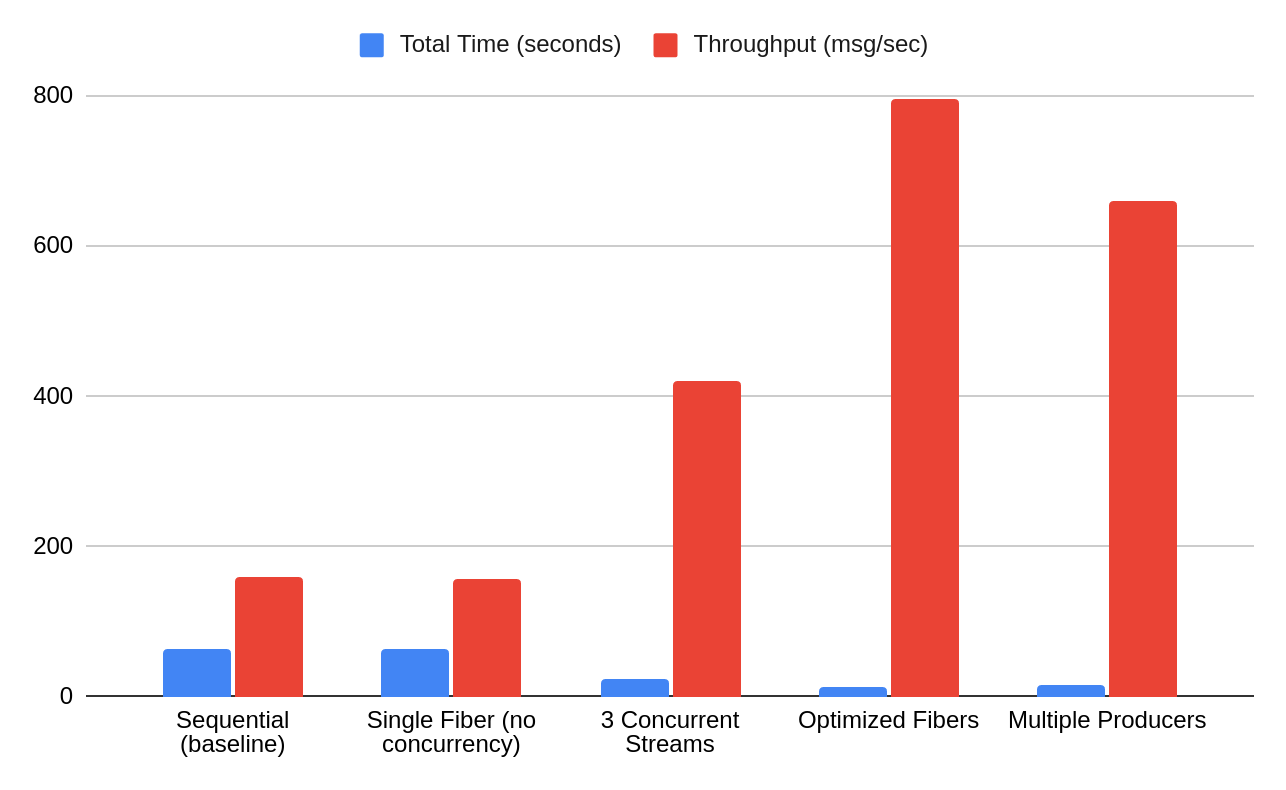
I benchmarked a Rails application processing 10,000 Kafka messages across various concurrency patterns:
Sequential processing (baseline):
Single fiber (no concurrency):
Real-world scenario (3 concurrent event streams):
Optimized fiber concurrency (controlled batching):
Multiple producers (traditional parallelism):
A single producer using fibers outperforms multiple producer instances (5.0x vs 4.1x) while using less memory and resources. This isn’t about making individual operations faster – it’s about enabling Ruby to handle concurrent I/O elegantly and efficiently.
What makes WaterDrop’s async integration cool is that it’s completely transparent:
# This code works with or without async
producer.produce_sync(
  topic: 'events',
  payload: data.to_json
)
Running in a fiber scheduler? It yields during I/O. Running traditionally? It blocks normally. No configuration. No special methods.
Transactions have limitations. Multiple transactions from one producer remain sequential due to the transactional.id design:
# These transactions will block each other
Async do |task|
  task.async { producer.transaction { ... } }
  task.async { producer.transaction { ... } } # Waits for first
endBut: transactions still yield during I/O, allowing other fibers doing different work to continue. For concurrent transactions, use separate producers.
class EventProcessor
  def process_user_activity(sessions)
    Async do |task|
      # Process different types concurrently
      login_task = task.async { process_logins(sessions) }
      activity_task = task.async { process_activity(sessions) }

      # Analytics runs during Kafka I/O
      analytics_task = task.async { update_analytics(sessions) }

      [login_task, activity_task, analytics_task].each(&:wait)
    end
  end

  private

  def process_logins(sessions)
    sessions.each do |session|
      producer.produce_sync(
        topic: 'user_logins',
        payload: session.to_json
      )
    end
  end
endWaterDrop’s async integration proves Ruby can compete in high-performance I/O scenarios without sacrificing elegance. Combined with Samuel’s broader ecosystem (async-http, async-postgres, falcon), you get a complete stack for building high-performance Ruby applications.
Try wrapping any I/O-heavy operations in Async do |task| blocks. Whether it’s API calls, database queries, or Kafka operations with WaterDrop, the performance improvement may be immediate and dramatic.
Find WaterDrop on GitHub and explore the async ecosystem that’s making Ruby fast again.
The post WaterDrop Meets Ruby’s Async Ecosystem: Lightweight Concurrency Done Right appeared first on Closer to Code.
Previously I have written about how useful public cloud storage can be when starting a…
This is Part 2 of the "Karafka to Async Journey" series. Part 1 covered WaterDrop's…
For many software teams, documentation is written after features are built and design decisions have…
With the release of the FIPS 140-3 certified cryptographic modules for Ubuntu 22.04 LTS, Canonical…
Open source libraries are repositories of code that developers can use and, depending on the…
Last year, we had the opportunity to speak at Regent’s UX Conference (Regent’s University London’s…